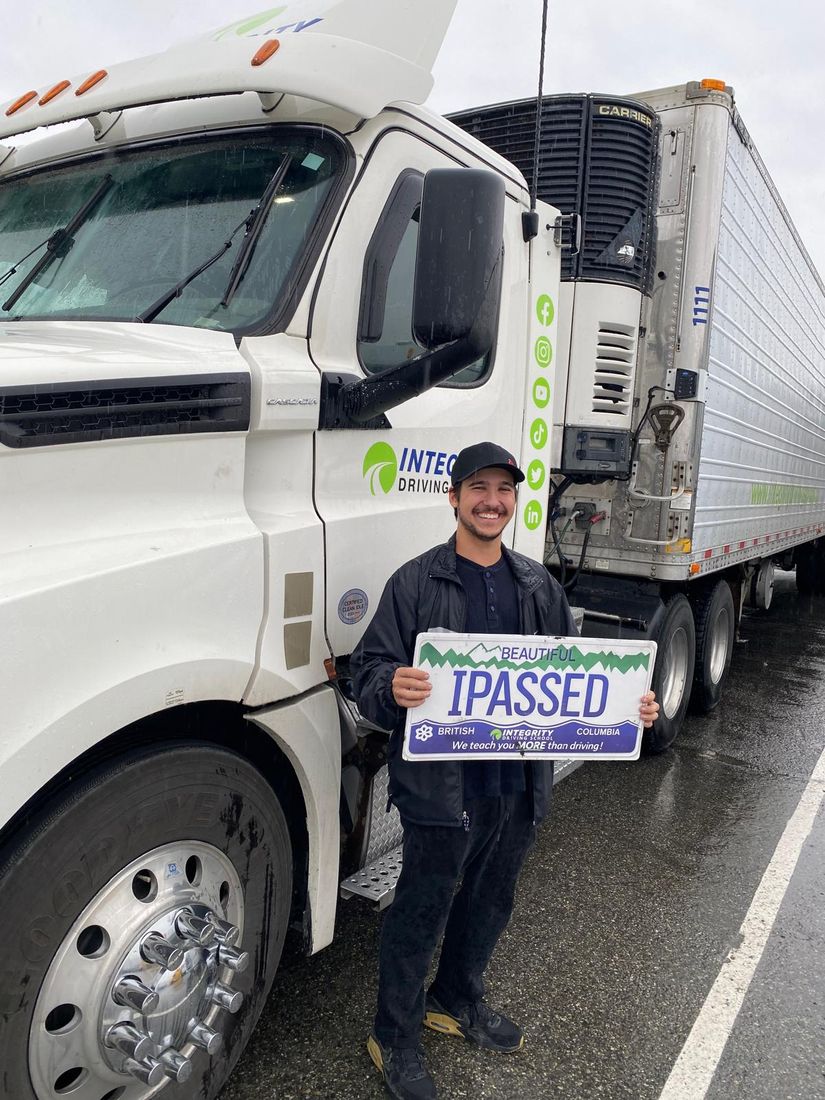
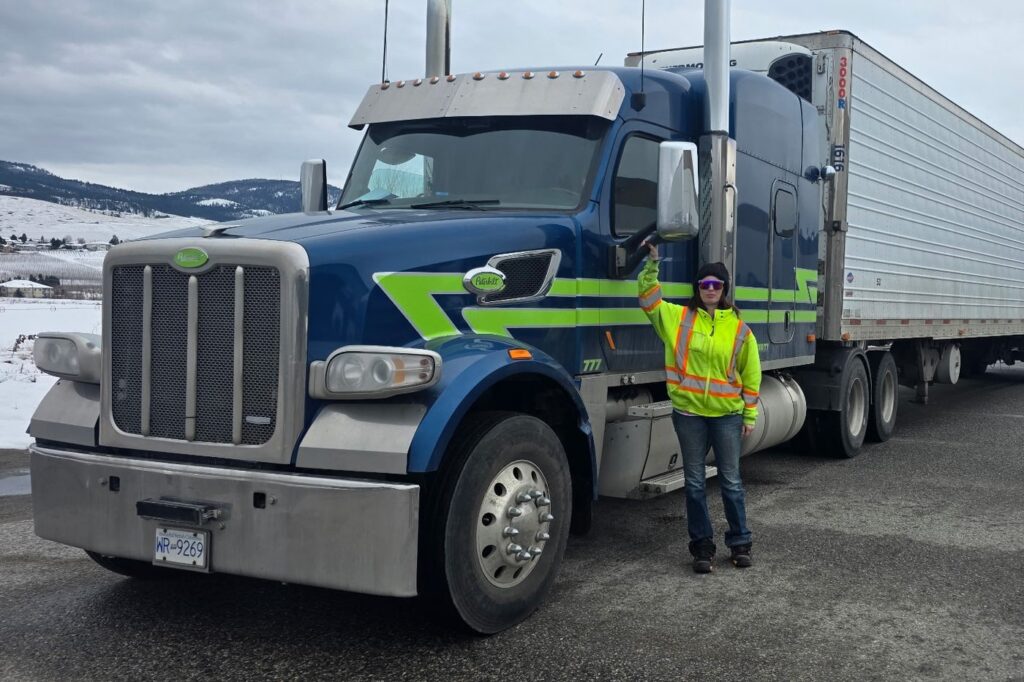
Those trucks going past are somebody’s career. It could be yours.
You have driven the Coquihalla. You have sat behind them on the hill. Roughly sixty percent of the freight between the coast and Alberta comes through this city, about 1,570 trucks a day on that highway alone.
Every one of them is being driven by somebody who went and got licensed.
You are not afraid of the work. You have done jobs that asked plenty of you and still left you counting days to payday. Effort was never what was missing.
A Class 1 changes what your effort is worth. The licence belongs to you, it is recognised across Canada, and nobody can take it off you. That is the difference between a job you can lose and a career you can carry.
It shows up in ordinary ways. Your family stops hearing that next year will be the same as this one. You walk into a yard and are taken seriously. And when you are ready for more there is a next step: better runs, better carriers, your own authority if that is where you are going.
What you do with it depends on the driver you become. We are not here to turn out truck drivers. We are here to turn out professional truck drivers, and in this industry those are two different things.
And what it asks of you in return
It is not easy money. Mountain grade, winter, early starts and nights away from home. The drivers who last are the ones who want the responsibility, not the ones looking for a shortcut.
We would rather say that before you pay than after. If that is the work you want, we will teach it properly and tell you honestly when you are ready for the test.
Our Kamloops campus is at 348 Tranquille Road, serving Kamloops, Merritt, Lillooet and 100 Mile House.
Request Information
Fill out the form below and one of our Student Admissions Advisors will get in touch with you.
The Coquihalla climbs from near sea level at Hope to over a kilometre of elevation in under 50 kilometres. Coquihalla Pass is 1,244 metres and Surrey Lake Summit is 1,444 metres. The summit takes around 1,150 millimetres of annual precipitation as snow, with an average peak snowpack of 235 centimetres.
You will learn the Great Bear Snowshed, and the brake check and chain-up areas at Zopkios and Box Canyon, because those are the places where a Class 1 driver either knows what to do or does not. You will also learn the rules that apply only to your vehicle. Commercial vehicles are restricted from the left lane northbound between Box Canyon and Zopkios, and again between Larson Hill and Inks Lake Hill.
Summit elevations: Province of British Columbia. Snow Shed Hill grade: TranBC.
Chains are the law here, not a suggestion
Winter tire and chain requirements run October 1 to April 30 on the mountain routes serving Kamloops. If your vehicle is 11,794 kilograms licensed gross weight or more, you must carry steel chains on most major BC highways.
When chain-up is in effect the counts are specific. A single truck chains the two outside drive tires. A truck with one trailer chains four drive tires. A truck with multiple trailers chains six. We teach this hands on, because a driver who has never installed chains in the cold does not install chains in the cold.
The scales you will cross
CVSE operates eastbound and westbound inspection stations at Kamloops, and the Highway 1 Kamloops Brake Check is being expanded with work running to summer 2027. Knowing how to arrive at a scale, what the officer is looking at, and what your paperwork needs to say is part of the job, so it is part of the training.
Your road test also happens here. ICBC conducts Class 1 testing in Kamloops, so you are not hauling a tractor-trailer to the coast to sit it. Students based in the Lower Mainland travel to Chilliwack or Coquitlam for theirs.
Who is hiring in the Thompson-Nicola
Arrow Transportation Systems has its head office here on McMaster Way. Van-Kam Freightways runs out of West Sarcee Street and Clark Freightways out of Camosun Crescent. Trimac, Westcan Bulk Services, Overland West and Arrow Reload at Campbell Creek all operate in the region, alongside NRI Distribution and the BC Liquor Distribution Branch.
The freight here is forest products, with the Domtar pulp mill moving around 408,000 tonnes a year plus Tolko and River City Fibre; mining out of New Afton and Highland Valley Copper; and industrial commodities including Nutrien fertilizer, Lafarge cement and Pounder Emulsions asphalt.
We cannot promise you a job. Employers and HR make that call and we have no control over it. What we can tell you is that the companies above move bulk, logs, fuel and industrial freight through mountain passes in winter, and that is the driver we train you to be.
Class 1 MELT cost in Kamloops BC
Training Costs by Campus
Get personalized pricing based on your preferred campus. Select your campus to see available packages and rates.
BC Mandatory Class 1 MELT
140 Hours
BC Mandatory Entry-Level Training.
$15,500
Tuition shown in Canadian dollars and is subject to change without notice. Commercial training programs are tax exempt. ICBC licensing, knowledge test and road test fees are not included. You will receive an Enrolment Certificate and a Tuition Receipt for your records.
Call us today for a free, no-obligation consultation – we are here to help you succeed.
Government Grants & Tuition Reimbursements available
What it costs
Class 1 MELT in BC is 140 hours, of which 47 are theory and the balance is in and around the truck. The tuition above covers the program. Call the Kamloops campus to confirm the current figure and exactly what is included before you budget.
Before you can start
A valid BC learner permit for the class you are training in, and ICBC eligibility for Class 1. The full list is on the Class 1 MELT program page.
What MELT stands for
MELT is Mandatory Entry-Level Training. It is the regulated minimum a new Class 1 driver in British Columbia must complete before taking the ICBC road test, and it is not optional. It sets the hours, the content and the standard every school has to meet.
In BC that means 140 hours, of which 47 are theory and the balance is in and around the truck, including at least 50 hours on the road. The full breakdown is on the Class 1 MELT program page.
Our record
98 percent pass rate. One road test is included, and we put you in for it when you are ready. If you do not pass, you work the skills you were marked down on, take additional lessons, and we rebook after the ICBC 14 day wait.
Training since 2011, across six campuses in British Columbia.
Paying for Class 1 MELT
RESP funds, a workplace training grant for employer-sponsored students, a receipt for every payment, and a T2202 because we are a Designated Educational Institution. Details on our financing and funding page, or call the Kamloops campus.
In Kamloops. ICBC conducts Class 1 road testing here, so you test in the city you trained in, on the roads you trained on. Students in the Lower Mainland have to travel to Chilliwack or Coquitlam to do the same thing.
Yes. Kamloops sits where Highway 1, Highway 5 as both the Coquihalla and the Yellowhead, Highway 5A and Highway 97 meet. Sustained grade, brake checks and chain-up areas are part of the training because they are part of the job here.
Yes, hands on. Chain requirements run October 1 to April 30 on the mountain routes serving Kamloops, and vehicles at 11,794 kilograms licensed gross weight or more must carry steel chains on most major BC highways.
Arrow Transportation is headquartered here, with Van-Kam Freightways, Clark Freightways, Trimac, Westcan Bulk and Overland West all operating in the region. The freight is forest products, mining and industrial commodities.
Give $100, Get $100
Refer a friend to Integrity Driving School and enjoy exclusive rewards together on their enrollment!